
HubSpot Data Agent: make CRM information useful
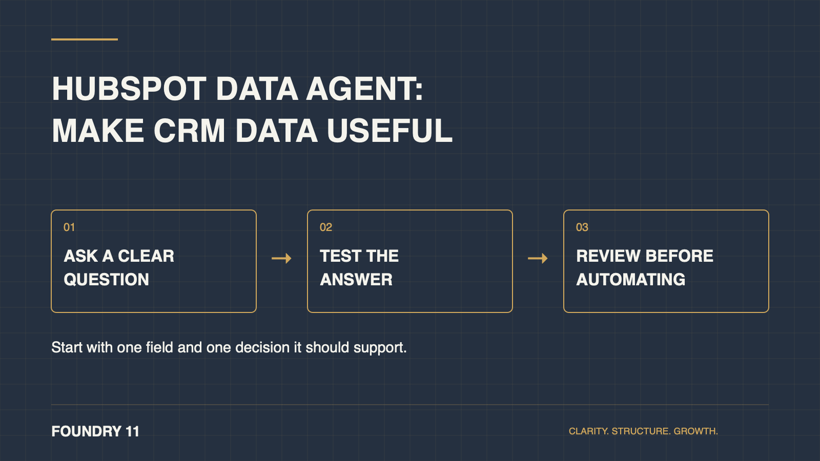
HubSpot Data Agent uses AI to research, interpret and transform information for work in your CRM. Its tools include smart properties, workflow actions and smart columns in Data Studio. A useful way to think about it is as help answering a defined question about a record, rather than a promise to make every piece of CRM data correct. HubSpot’s Data Agent guide explains the available tools.
If you are new to agents, start with our HubSpot agents overview. Here, the focus is on choosing a small data task whose answer your team can check.
Start with a question that supports a decision
Imagine an account team reviewing customer handover notes. The service lead wants a short summary of the customer’s stated implementation priority, so they know what to discuss first.
A proposed task could be: “Using the supplied handover note, summarise the priority the customer explicitly stated. If no priority is stated, return ‘Not stated’.”
This is an illustrative prompt, not a configured HubSpot feature or a claimed customer result. Its usefulness depends on the source text, the chosen tool and the quality of the result. The service lead should still read the original note when the summary is unclear or consequential.
A narrower question is easier to evaluate than “improve our customer data”. Before testing, name the person who will use the answer and the decision it should support.
Choose the right tool and information
HubSpot describes smart properties for AI-generated answers stored in properties, smart actions for work in workflows and smart columns for analysis in Data Studio. Access and requirements vary by feature. Check the specific tool against your subscription and account configuration. See the Data Agent guide.
For a workflow using the Custom prompt action, HubSpot says the model is not connected to the internet and needs the relevant context included in the prompt. Do not assume it can read every note or activity simply because that information exists somewhere in the CRM. Research and Custom prompt are distinct actions with different uses. HubSpot’s workflow guide explains the distinction.
For our handover example, the proposed input is the relevant note, not an unrestricted collection of customer information. Ask your account owner which data is appropriate to use and which permissions are required.
Test before allowing outputs to drive work
HubSpot’s Data Agent playground lets you try pre-built scenarios using live records. Its current documentation says those tests do not update records or consume HubSpot Credits. They are an opportunity to explore the tool, not a substitute for testing the exact workflow you later configure. Read the playground guide.
For a custom pilot, our recommendation is to begin with a sample that a reviewer can assess against the original material. Include clear examples, ambiguous notes and records with missing information.
| Example to test | What the reviewer should check |
|---|---|
| The priority is stated clearly | The summary preserves the customer’s meaning. |
| Two priorities appear in the note | The output does not invent an order of importance. |
| No priority is stated | Missing information remains visible. |
| An old and a recent note conflict | The agreed source rule is applied. |
| The note includes irrelevant detail | The summary stays focused on the task. |
These are proposed acceptance criteria. Keep the result separate from the operational field until you have agreed how it will be reviewed and corrected.
Decide what happens after an answer is generated
An AI output becomes more consequential when another process acts on it. A summary for a person to read is different from a value that changes routing, triggers outreach or affects reporting.
Before connecting the output to downstream work, map the consequences. If a result is missing or wrong, does someone notice? Can the process continue safely? Who can stop it and correct affected records?
For Data Agent workflow actions, HubSpot documents using outputs in later actions and branches. It also notes that insufficient credits can cause the Custom prompt action to fail with a null output. Design the missing-result path deliberately. See the workflow requirements.
If a value can be derived from a reliable existing field using a straightforward rule, assess that option too. AI interpretation is most useful where the question actually requires interpretation or research.
Check costs and ownership before scaling
Standard Data Agent actions can consume HubSpot Credits. Confirm the rate, account access and repeat-run behaviour for the feature you choose before estimating cost across a large set of records. Our AI costs checklist sets out the budget questions.
Name an owner for the prompt, source definition and result quality. Record how many outputs are useful, how many need correction and how much time review takes. Recheck those results when your source material or business process changes.
Start with the CRM cleanup checklist if ownership and field definitions are unclear. An agent cannot decide what your business means by a trustworthy record.
What is a sensible first Data Agent job?
Choose one question, one source definition and one person who will use the answer. Prove that it helps a real decision before letting it drive wider automation.
Which CRM question is your team still answering by hand? Talk with Foundry 11 about the information, workflow and checks needed for a useful first test.
Common questions
Does Data Agent automatically fix the whole CRM?
Start with a defined task. Correctness depends on what the field means, which sources are used and how the output is checked.
Can I try the playground without changing records?
HubSpot’s current playground documentation says its test results are temporary and do not update CRM records. Check the separate behaviour of any action you configure afterwards.
When should an AI answer trigger another action?
After you have tested its quality, agreed acceptable uncertainty and designed the path for a missing or incorrect result. Start with human review when the consequences need judgement.